48 QUESTIONS · QUESTIONNAIRE V2
Liberty & cooperation
Liberty88%
Cooperation81%
Equality75%
Synthetic answers, real scoring.
Not a person or a measured group.
Take the free 12 axes political test to explore your beliefs across twelve dimensions. Choose 48 or 72 questions and get instant results. Your answers stay in this browser.
48 QUESTIONS · QUESTIONNAIRE V2
Liberty88%
Cooperation81%
Equality75%
Synthetic answers, real scoring.
Not a person or a measured group.
Go beyond left and right. See how your priorities come together, and where there’s room for nuance.
Look at the principles behind your answers, without being reduced to a single label.
Explore how your views on cooperation, borders, and security fit together.
Notice where your beliefs cross the usual political dividing lines.
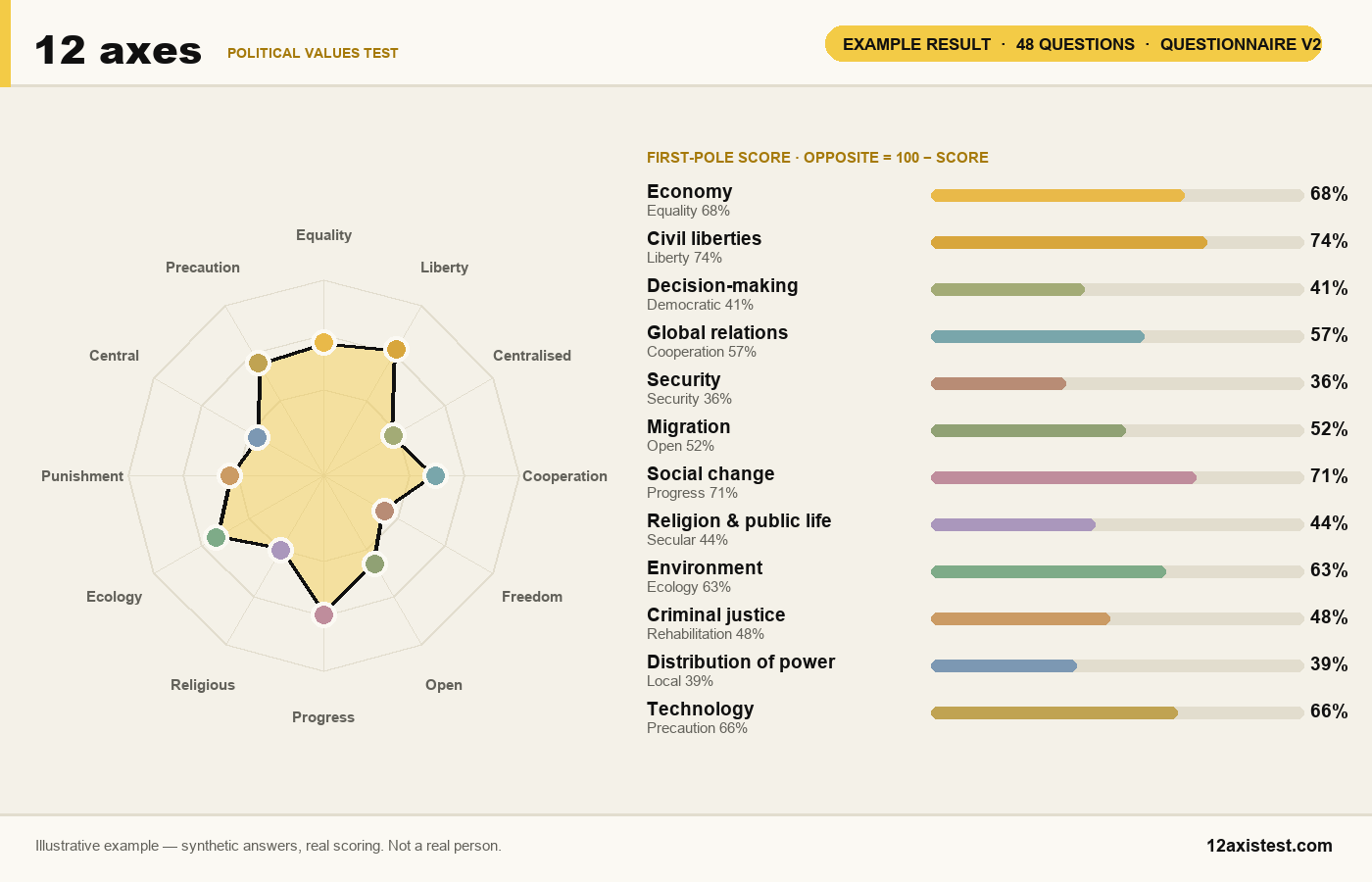
See both poles of every scale, with a clear visual breakdown of your answers.
Your answers and progress stay in your browser. No account or tracking required.
Download an image, print your results, or choose to share a result link.

Your views can lean in different directions on different subjects. Every scale gives you a separate piece of the picture.
Explore a radar chart, twelve paired scores, and plain-language explanations. Every answer counts, including neutral.
Read your result as an invitation to think about personal freedom, responsibility, and the limits of public power.
Explore this dimension →Example scores calculated from synthetic answers to the 48-question test. They do not describe a real person.
Take the 12 axes political testRead a statement, give your honest response, and see where you stand on twelve separate scales. Read the political test scoring method to see how answers become percentages and what the results can tell you.
Choose how much you agree with ideas about the economy, society, freedom, the environment, and more.
Your answers are averaged within each axis. Both ends of every scale stay visible, so you can read the balance.
Review your complete profile, learn what each score means, and save or share the result if you choose.
Different subjects deserve different questions. These twelve dimensions keep the trade-offs separate.
How should society balance economic equality with market freedom?
How much individual freedom should give way to public order?
Who should have the strongest voice in public decisions?
How should countries balance shared rules with national independence?
What role should military power play in preventing and resolving conflict?
How open should a country be to people who want to move there?
How should society weigh new social norms against established customs?
How much influence should religious traditions have on public policy?
How should environmental protection be weighed against economic expansion?
What should the criminal justice system prioritize after an offense?
At what level should most public decisions be made?
How should society balance the risks of new technology with its potential benefits?
Political language brings together many ideas. These are starting points for understanding your separate scores.
Public provision, redistribution, and reducing large differences in wealth.
Adapting institutions and norms as people develop new ways of living.
Combining different priorities rather than choosing one pole on every topic.
Competition, private enterprise, and individual economic choice.
Continuity, inherited customs, and a cautious approach to social change.
Maintaining national control over rules and international commitments.
Protecting personal autonomy and putting limits on state power.
Giving communities more authority over decisions that affect them.
No single category captures a person’s beliefs. This is an educational model, not a scientific assessment.
What the test does, how your results work, and why your answers belong to you.
It’s a free questionnaire that organizes your political preferences into twelve separate dimensions, including the economy, personal freedom, culture, and the environment. It is designed for reflection, not for assigning a definitive political identity.
Yes. Both test lengths, all twelve scores, explanations, and image downloads are free. There are no accounts, premium reports, or payment steps.
The quick version has 48 questions and takes about 6–9 minutes. The full version has 72 questions and takes about 10–15 minutes. Both cover all twelve axes and include your complete results for free. You can return to earlier questions or resume saved progress in the same browser.
This test reports twelve separate dimensions rather than a single position on a two-axis chart. You can lean toward different poles on different subjects. Other political quizzes use their own questions and scales, so scores are not interchangeable.
No. This original questionnaire has not been independently validated. Scores reflect your answers to a limited set of statements, not an objective measurement, diagnosis, or prediction of your behavior.
While a test is in progress, its answers are saved only in this browser. After completion, we keep the scores and a small explanation summary, including at most two answer examples per axis; the complete answer list is no longer saved. Optional Google Analytics and Microsoft Clarity run only after you allow analytics. We measure page visits and basic test actions without sending your answers or scores as analytics data; session recordings exclude questionnaire and result pages. You can clear local test data or change analytics preferences in the footer. Cloudflare still receives normal website requests.
Yes. Download an image, print your result, or copy an optional share link. Share links contain only the twelve scores, questionnaire version, and quick/full mode, not answer examples or contribution counts. Anyone with the link can view those scores.
New v2 tests have 48 or 72 statements with balanced scoring directions. Saved v1 sessions can finish with their original 36 or 72 statements. Old results keep their original scores and version; they are not recalculated or directly comparable with v2.
Different statements, your interpretation, and your views at the time can all change a score. A short test is especially sensitive to individual answers. Read each dimension as a conversation starter rather than a fixed label.
Anyone who wants more than one left-to-right line, without being told what their answers mean.
The 12 axes political test works as a classroom prompt. Twelve separate scales give a discussion group something concrete to compare, and every result is calculated in the browser, so nobody has to hand over their answers.
If a political compass felt too narrow, the 12 axes political test keeps economy, liberty, security, culture, and technology apart instead of averaging them into a single point. Reading twelve scores is slower than reading one, and it says more.
Compare result links side by side. A link from the 12 axes political test carries only the twelve scores, so you can talk about where you differ without publishing individual answers. Nothing is stored on a server.
Start with a quick look or spend a little longer reflecting. Both versions of the 12 axes political test cover all twelve dimensions and give you your complete result for free.
A useful test should be transparent, easy to use, and open to thoughtful feedback.
No account. Your answers stay in your browser.
See exactly how responses become percentages.
An independent questionnaire, written for this project.
All versions, results, downloads, and sharing.